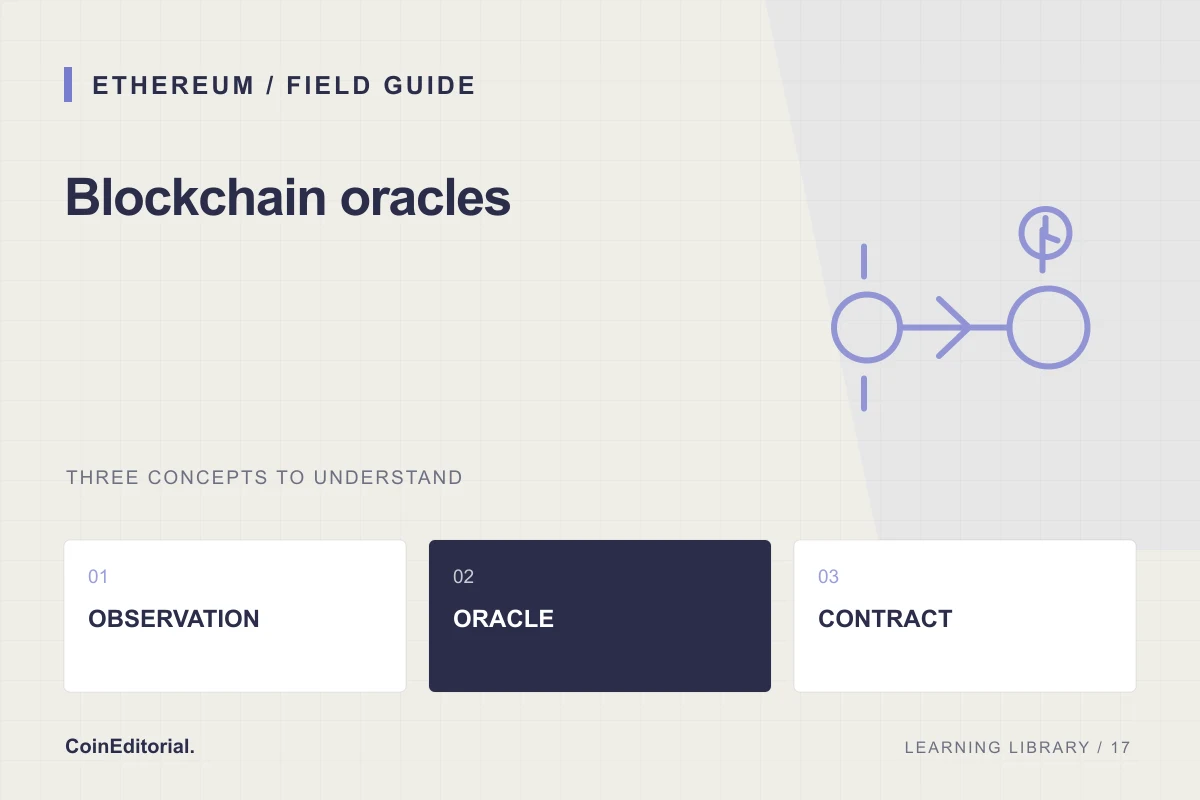
A valid on-chain message can still contain stale or unsuitable data.
The boundary between a chain and the world
A blockchain does not automatically know a market price, weather event or delivery result. Oracles provide a mechanism for making outside information available to contracts. Ethereum’s oracle documentation distinguishes data sources, delivery models and trust assumptions. Chainlink’s feed documentation illustrates why applications must understand the selected feed rather than treat all numerical outputs as interchangeable.
Freshness is part of meaning
Suppose an application receives a hypothetical price of $100 with a timestamp from yesterday. The number may be accurately recorded and signed, yet unsuitable for a decision requiring today’s price. A consumer needs an explicit freshness policy and a response when data is missing or too old. Silently substituting zero is not a neutral choice when the value influences financial calculations.
The feed must match the question
An asset pair, denomination, network and update policy all matter. A feed intended for one market or purpose may be inappropriate for another. Check decimal scaling as well as units. A tenfold arithmetic error and a stale observation can both produce a plausible-looking interface unless the application validates context alongside the value.
A useful consumer checklist
Record the official feed address, supported use, timestamp field, update behaviour and fallback policy. Test stale, unavailable and extreme values in a controlled environment. Describe the result as a test of the consumer’s handling, not proof that every future observation will be correct. Oracle reliability is a chain of responsibilities, from measurement through delivery to the application that decides how to act.
Sources & further reading
Sources checked 7 October 2026. Source-linked explanatory content; not personalised investment advice. Found an error? Request a correction.