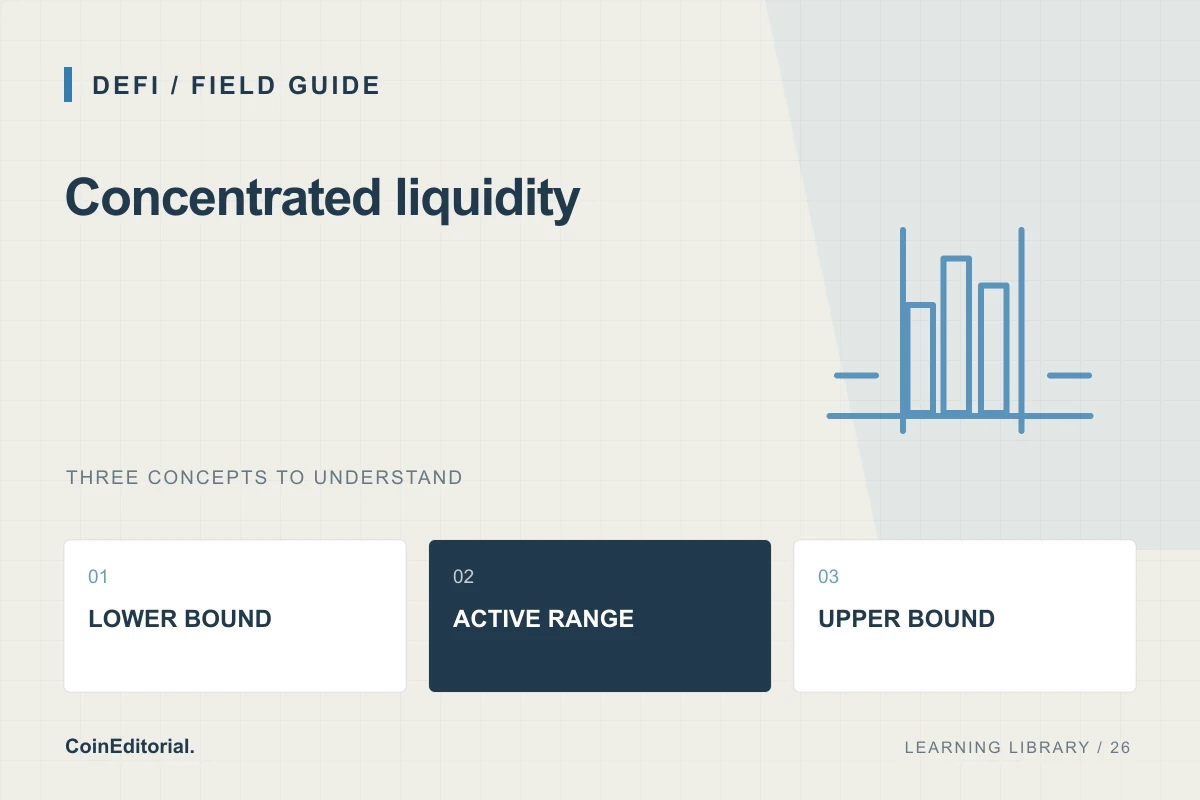
A position only supplies active liquidity while price is inside its selected range.
Capital has a location
Concentrated-liquidity designs let providers choose price intervals for their capital. Uniswap’s documentation explains how liquidity becomes inactive when price moves outside a position’s bounds. A pool can therefore hold substantial total value while providing very different depth at particular prices. The choice of range is an active exposure decision, not just a cosmetic setting in a dashboard.
A range example
Imagine a fictional pair quoted near 100, with one position covering 95 to 105 and another covering 80 to 120. If price moves to 110, the narrower position is outside its range while the wider one can remain active. This says nothing by itself about which earned more overall. Fees, price path, inventory changes and the cost of repositioning all matter.
Inventory changes as people swap
A provider’s mixture of assets changes through trading. At a range boundary the position can become entirely one asset. Out-of-range does not simply mean a chart failed to refresh. It can represent a real change in the position’s composition and fee-generating status. Understand the protocol’s withdrawal and fee-collection mechanics before assuming the initial deposit ratio persists.
Evaluate a position, not a headline rate
Record the bounds, current price, active status, asset quantities, accrued fees and any management charges. Compare performance with holding the original assets over the same period. A narrow range can increase capital efficiency while also demanding more attention; it does not guarantee higher net returns. The right explanation makes these trade-offs visible instead of presenting a high annualised number without its operating assumptions.
Sources & further reading
Sources checked 7 October 2026. Source-linked explanatory content; not personalised investment advice. Found an error? Request a correction.