A pool position can rise in dollar value while underperforming the assets held outside it.
Choose the correct comparison
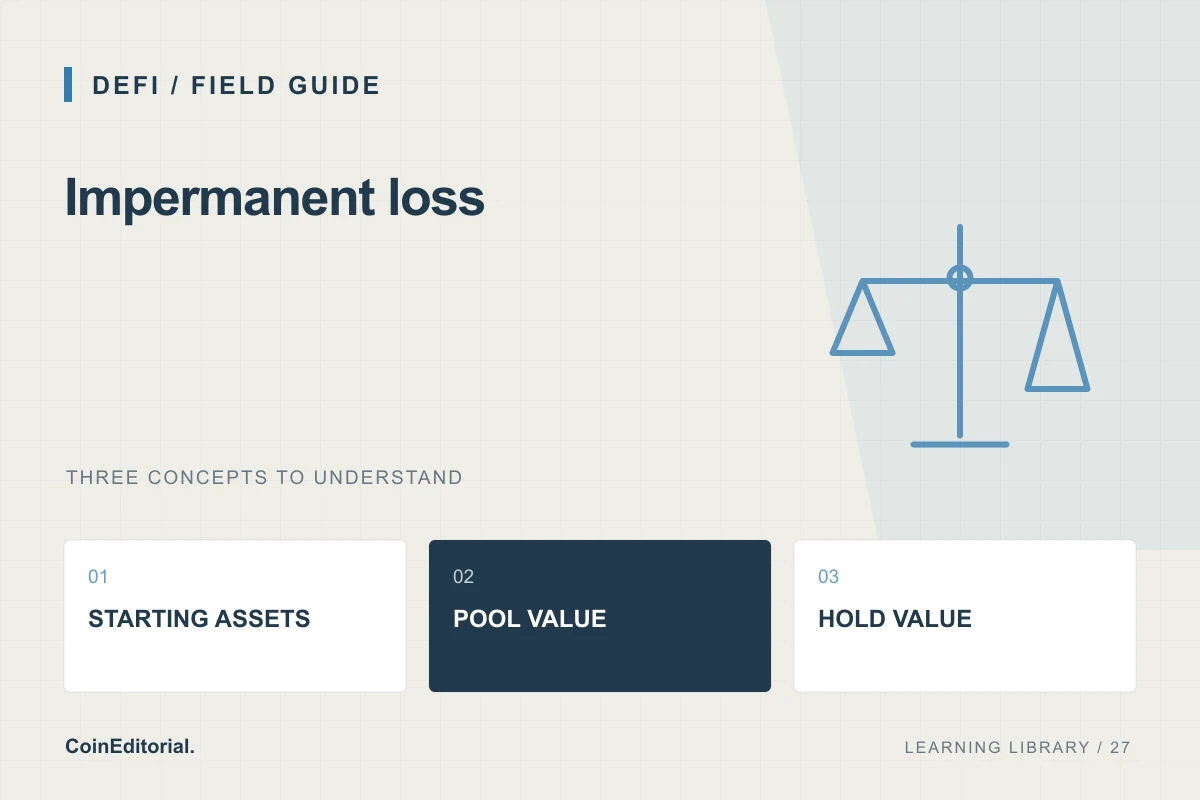
Impermanent loss describes a difference between the value of a liquidity position and holding the initially deposited assets, under the model being analysed. Uniswap’s return documentation discusses this comparison. The word “impermanent” does not make the difference irrelevant or guarantee recovery. Fees can offset some or all of it, but that is an outcome to measure rather than assume.
A simplified numerical example
Start with a hypothetical fee-free constant-product pool containing 1 token priced at $100 and $100 of a stable asset. Initial value is $200. If the token price doubles and arbitrage aligns the pool, reserves become about 0.7071 token and $141.42, worth $282.84. Holding the original assets would be worth $300. The difference is about $17.16, or 5.72% relative to holding.
Know the assumptions
This example ignores fees, incentives, transaction costs and changes in the stable asset’s value. It also assumes the basic full-range constant-product design. Concentrated positions behave differently and need their own analysis. A real performance report should state these assumptions explicitly. Comparing a live position with a simplified formula without matching the design can create a precise-looking but misleading result.
Measure the whole result
Record starting quantities, deposits and withdrawals, remaining inventory, fees actually received and all costs. Compare with a clearly specified holding benchmark at the same end time. Distinguish token-denominated earnings from their changing currency value. This turns a vague yield claim into an auditable accounting exercise and helps explain why earning fees alone does not establish that providing liquidity was better than holding the same assets.
Sources & further reading
Sources checked 7 October 2026. Source-linked explanatory content; not personalised investment advice. Found an error? Request a correction.