A displayed wallet balance can consist of many separately spendable outputs.
The building blocks of a balance
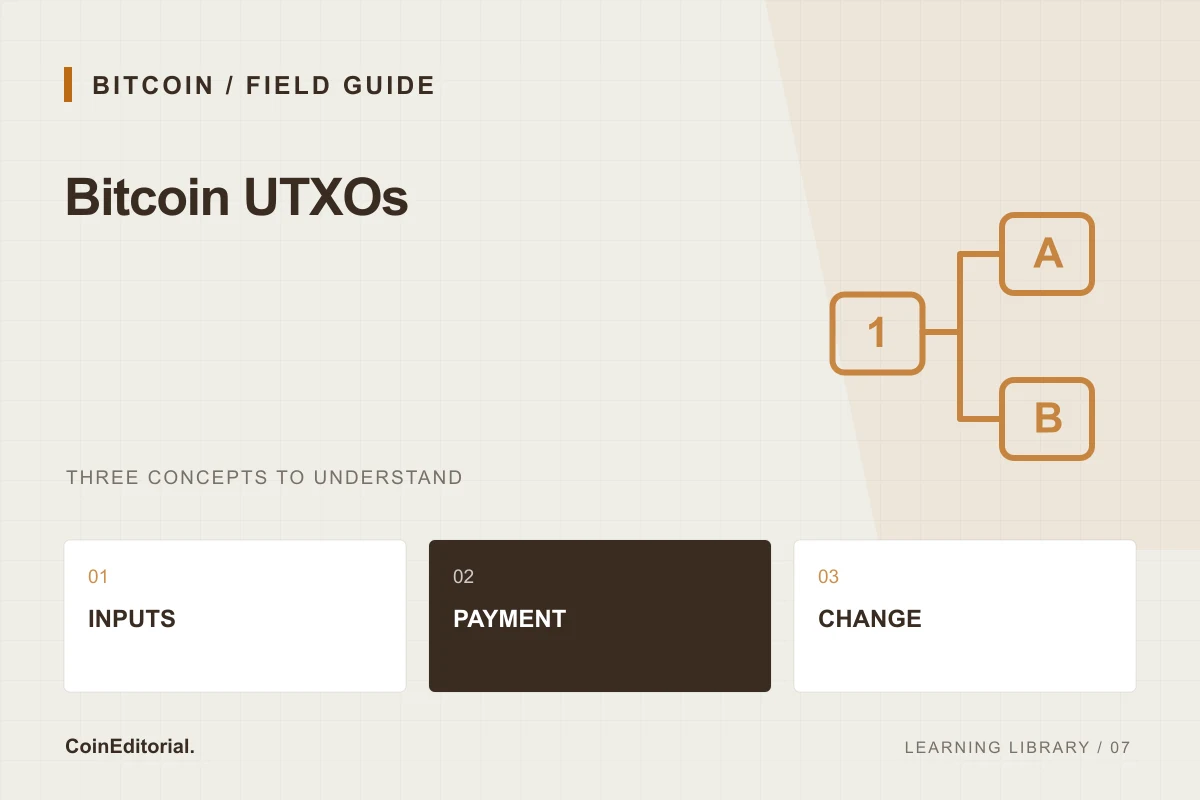
Bitcoin transactions spend previous unspent transaction outputs, commonly shortened to UTXOs, and create new outputs. A wallet selects inputs and constructs spending conditions for the new outputs. The balance shown in an interface is an aggregation, not necessarily one indivisible entry. Understanding this model helps explain change addresses and why two payments of the same value can have different transaction sizes.
Follow a hypothetical payment
Assume a wallet spends one 0.010 BTC output to send 0.006 BTC and pays a 0.0001 BTC fee. A simple transaction could create 0.006 BTC for the recipient and 0.0039 BTC back to a change address controlled by the sender. The arithmetic is 0.010 minus 0.006 minus 0.0001. These are teaching numbers, not a current fee estimate.
Why the explorer may look unfamiliar
A change address may be new even though it belongs to the same wallet. An explorer listing two outputs does not automatically mean that the sender paid two different people. Address labels are not definitive identity evidence. When reconciling a payment, compare the intended recipient, the amount and the transaction identifier with the wallet’s own record rather than guessing from the number of outputs.
What the reader can check
Without moving funds, inspect a historical transaction and add its output values. Compare them with the inputs and identify the fee difference. Do not try to identify the change owner solely from output order or size. The exercise teaches the accounting model; it does not require importing a wallet, exposing a recovery phrase or giving an explorer permission to sign anything.
Sources & further reading
Sources checked 7 October 2026. Source-linked explanatory content; not personalised investment advice. Found an error? Request a correction.