Try the Proof Engine ↗ · Read the official PVTY guide ↗
PactVerity official links
Published Solana mint8a9P2My6dUhKYJacztYv6bSjKJ1XZwTYY3qz5VwgcGMLA stronger AI economy needs more than confident claims. PactVerity offers a practical starting point: receipts that other people can inspect and recheck. PVTY is the associated Solana token; its proposed protocol utility is still in development.
From service claims to evidence
As software agents take on more work, a basic question becomes more important: what actually happened? PactVerity addresses the evidence layer of that question. Its published Proof Engine accepts measurable service inputs, evaluates explicit rules and produces a portable receipt. For developers and service buyers, the appeal is a record that can travel beyond the original interface and be checked again.
A product readers can explore today
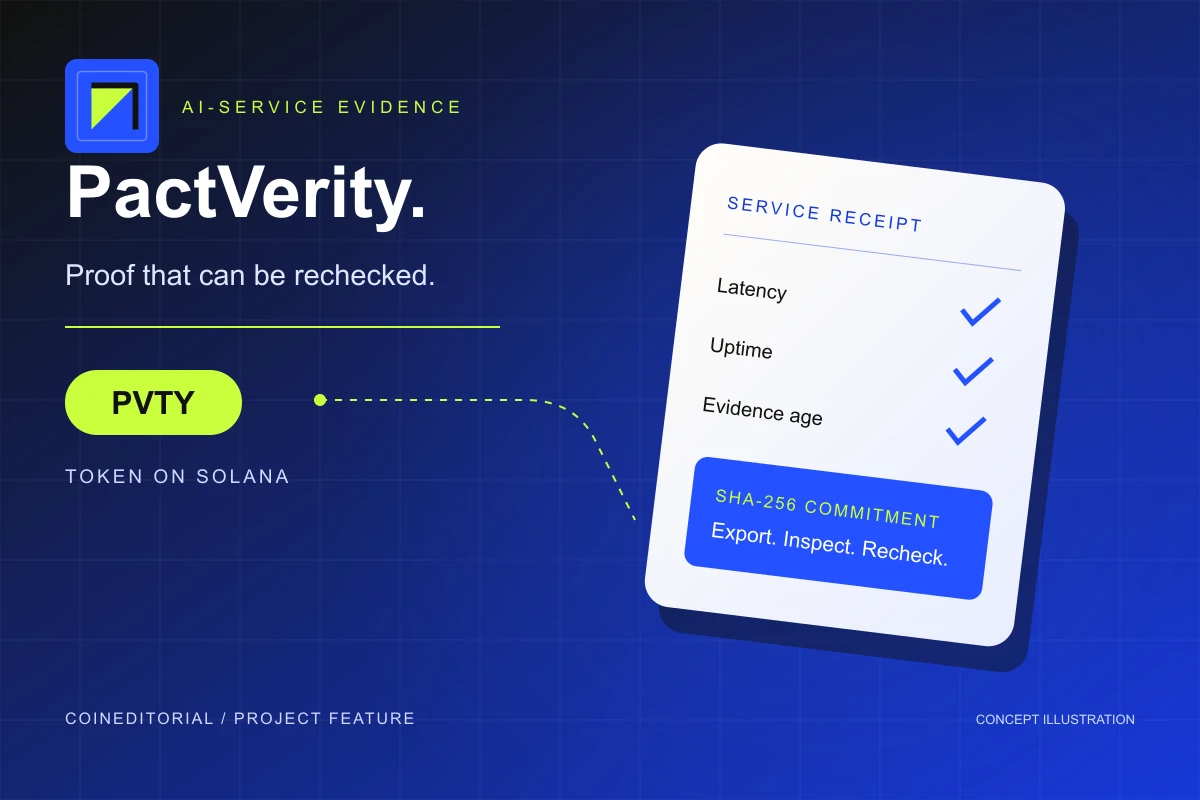
According to the project’s current documentation, Proof Engine v1 evaluates latency, uptime, evidence age and an optional output commitment. A SHA-256 digest helps detect changes to the receipt; importing the record repeats the checks. Optional Ed25519 signing connects a receipt to a signing key. This is a working MVP, not independent certification: the engine uses caller-supplied measurements and does not itself prove their truth, confirm delivery or execute refunds. That distinction is essential when assessing what the technology can support.
PVTY: one token identity on Solana
PVTY is the token associated with PactVerity on Solana mainnet. The official guide records an original issuance of 50 million tokens. Original issuance is not the same as current supply or circulating supply: burns and allocations must be examined separately. The project previously used the PactLayer / PACT branding; its published guide identifies the same mint as the reference for the current identity. Readers should compare the complete address, not rely on a familiar ticker or logo.
The utility roadmap, without confusing plans with delivery
PactVerity describes provider staking, verifier staking, slashing and governance as planned protocol functions. The intended role is to connect participation and accountability to the service-verification system. These mechanisms are not deployed token benefits today. The project also describes stablecoin payments for protected services as part of its proposed architecture, rather than treating PVTY as a substitute for stable payment units. Readers can evaluate the Proof Engine and Receipt API beta without buying the token. Holding PVTY does not provide company ownership, a revenue entitlement or guaranteed value.
The growth opportunity: evidence that travels
PactVerity’s potential distribution advantage is the receipt itself. If developers embed recheckable records in useful applications, the evidence can reach users beyond the project’s own community. That creates a possible path from product discovery to wider awareness of PVTY. The milestones worth watching are independent integrations, repeat API usage, third-party reproductions and delivery of the proposed token functions. Those would demonstrate progress; social attention alone would not. This is a growth thesis, not evidence that PVTY is already viral or a forecast of its future size or price. Product adoption does not automatically translate into token demand.
Make the evidence part of the decision
The useful next step is practical: explore the Proof Engine, inspect the token guide and follow its allocation and verification links. Ask whether each claim refers to working software, a project-reported record or a future milestone. A supply cap does not create demand by itself, and a liquidity lock does not prevent holders selling or protect the token’s price. Trust is strengthened by evidence that remains available for scrutiny, not by treating a roadmap as a completed product.
Market access and what to check
The official PVTY guide links to independent market charts and buy/swap guidance. Availability depends on the route, provider and jurisdiction; an article is not confirmation that a particular order can execute. Check the current quote, fees, price impact and minimum received. PVTY is speculative, with shallow-liquidity and volatility risks, including possible total loss. This overview is based on the project’s published documentation, not an independent security audit, investment endorsement or recommendation to buy.
Sources & further reading
- PactVerity Proof Engine: capabilities and limits ↗
- Official PVTY guide and mint identity ↗
- PVTY tokenomics and planned utility ↗
- Allocation and treasury evidence ↗
- Project transparency register ↗
- Independent-route buy/swap guide ↗
Sources checked 7 October 2026. Source-linked explanatory content; not personalised investment advice. Found an error? Request a correction.